Product case studies

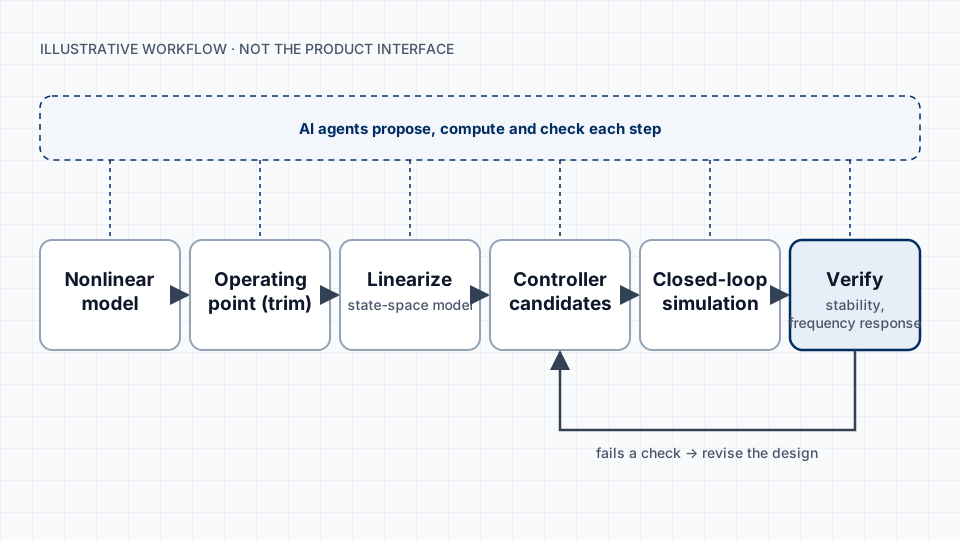
Illustrative diagram of an AI-assisted control-design workflow: model, operating point, linearization, controller candidates, closed-loop simulation and verification, with AI agents supporting each step.

Product case studyMVP · readiness gate passed

Taking an AI control-design platform from concept to a validated MVP

Problem
Control-system design runs through many specialist steps, from modelling and linearization to controller design and verification, and they are slow to repeat by hand.
My role
Technical Product Manager, promoted from the engineering team. I own discovery, requirements, the backlog, delivery and go-to-market planning.
Main decision
Prove the product with test users and pass a readiness gate before any go-to-market work.
Evidence
Two proof-of-concept cycles completed (the first had 38 academic test users and 198 projects). Internal readiness gate approved.

Read the case study
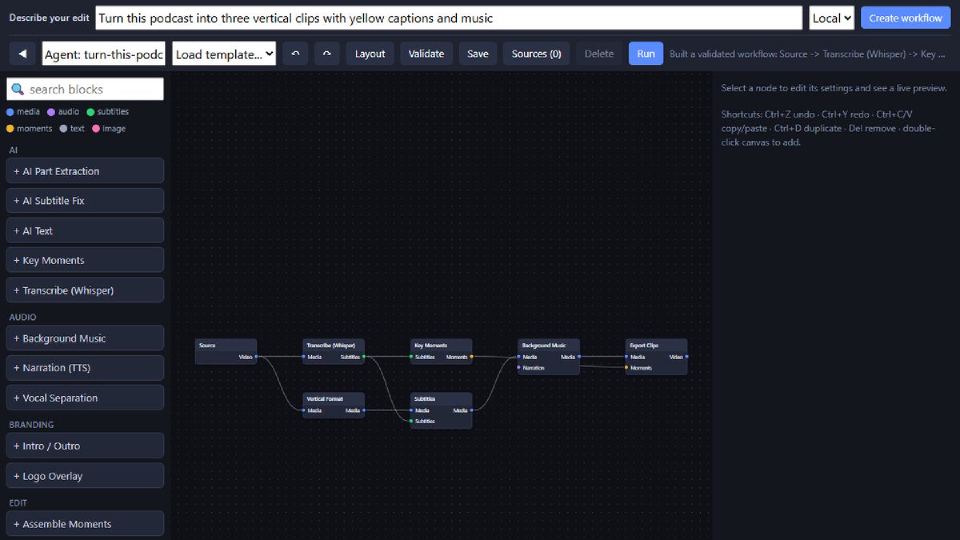
ViGenX editor with a plain-language brief at the top and the generated workflow graph below it.

Product case studyPre-1.0 · open source

ViGenX: an AI video editor that shows its plan before it runs

Problem
One-prompt video tools return a finished render. You can't inspect it, adjust one step, or safely repeat it.
My role
Independent product and technical lead, covering the vision, MVP scope, roadmap and build.
Main decision
The language model plans but does not execute. Every brief becomes a typed workflow that waits for approval.
Evidence
Public repository with CI and tests. The initial MVP was shown at Diginext's 10th Startup Camp. No external usage data yet.

Read the case study Repository

Technical and research case studies

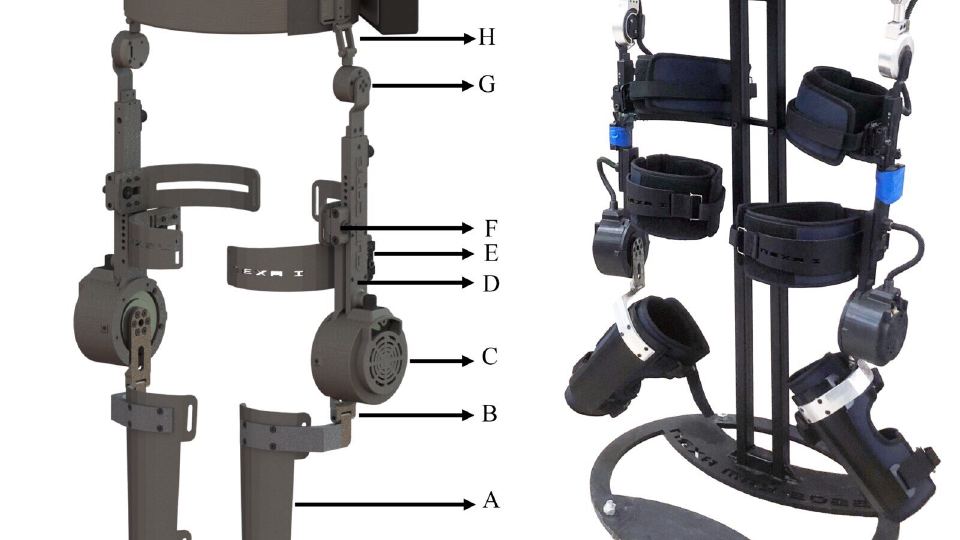
FUM-NEXA knee exoskeleton shown as a CAD design and as the manufactured prototype.

Technical case studyResearch prototype · preprint

Adaptive sit-to-stand assistance for the FUM-NEXA knee exoskeleton

Problem
Fixed torque profiles can't tell a user who needs help from one who doesn't, and the device's own weight adds effort.
My role
Project manager and first author in a university lab team. I owned the control concept and its ROS2 integration.
Main decision
Estimate how much help the user needs from signals the robot already has, and scale a reference torque by that amount.
Evidence
With five healthy subjects, muscle effort was 30.34% lower than without the exoskeleton at slow speed and 7.59% lower at fast speed.

Read the case study

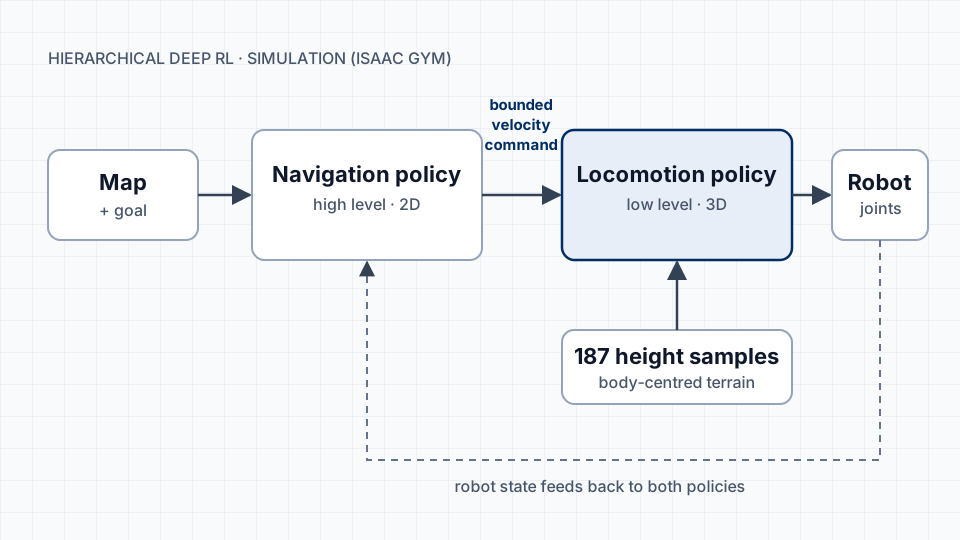
Diagram: a navigation policy sends a bounded velocity command to a locomotion policy, which also reads terrain height samples and drives the robot's joints.

ResearchSimulation research · thesis in progress

Hierarchical reinforcement learning for quadruped navigation

Problem
A single policy struggles to plan a route and keep a legged robot stable on rough terrain at the same time.
My role
Second author. I designed the hierarchical architecture and implemented the reinforcement-learning path-planning component.
Main decision
Split navigation and locomotion into two policies linked by a bounded body-frame velocity command.
Evidence
In Isaac Gym simulation, 94.2% navigation success and 71.4% fewer collisions than a monolithic baseline.

Read the case study

Other technical work